 Add to Chrome
 Add to Firefox
 Add to Edge
Verus-SpecGym: An Agentic Environment for Evaluating Specification Autoformalization
May 26, 2026
AI coding agents are increasingly used to write real-world software, but ensuring that their outputs are correct remains a fundamental challenge. Formal verification offers a promising path: an agent generates code together with a machine-checked proof, guaranteeing that the code satisfies a formal specification. However, there is no guarantee that the formal spec itself matches the user's intent. In this work, we study specification autoformalization: whether LLM agents can translate informal programming problems into faithful formal specifications. We introduce Verus-SpecBench, a benchmark of 581 spec-writing tasks derived from Codeforces problems targeting Verus, a verifier for Rust, and Verus-SpecGym, an agentic environment in which models interact with Verus, bash, & the filesystem to develop these specs. The central challenge is evaluation: expert-written reference specs are expensive to write, & LLM judges can miss subtle mistakes. We address this by (a) extending Verus's exec_spec mechanism so that generated specs can be executed as Rust code, & (b) testing them against official Codeforces tests & adversarial cases extracted from Codeforces "hacks", which are edge cases written by competitors to break incorrect solutions. On Verus-SpecBench, the strongest model, Gemini 3.1 Pro, solves 77.8% of tasks, other frontier models solve 51.1--57.8% & OSS models reach only 21.5--25.5%. Our analysis of failure modes shows that model-generated specs can omit important input assumptions, accept incorrect outputs, & reject valid ones. We also find that LLM-as-a-judge evaluation misses 26% of the failures our evaluator catches. Overall, our results suggest that spec autoformalization is within reach for frontier agents but remains brittle even on problems where they can already generate correct code. The code, data, & logs can be found at https://github.com/formal-verif-is-cool/verus-spec-gym

On the limits and opportunities of AI reviewers: Reviewing the reviews of Nature-family papers with 45 expert scientists
May 20, 2026With the advancement of AI capabilities, AI reviewers are beginning to be deployed in scientific peer review, yet their capability and credibility remain in question: many scientists simply view them as probabilistic systems without the expertise to evaluate research, while other researchers are more optimistic about their readiness without concrete evidence. Understanding what AI reviewers do well, where they fall short, and what challenges remain is essential. However, existing evaluations of AI reviewers have focused on whether their verdicts match human verdicts (e.g., score alignment, acceptance prediction), which is insufficient to characterize their capabilities and limits. In this paper, we close this gap through a large-scale expert annotation study, in which 45 domain scientists in Physical, Biological, and Health Sciences spent 469 hours rating 2,960 individual criticisms (each targeting one specific aspect of a paper) from human-written and AI-generated reviews of 82 Nature-family papers on correctness, significance, and sufficiency of evidence. On a composite of all three dimensions, a reviewing agent powered by GPT-5.2 scores above each paper's top-rated human reviewer (60.0% vs. 48.2%, p = 0.009), while all three AI reviewers (including Gemini 3.0 Pro and Claude Opus 4.5) exceed the lowest-rated human across every dimension. AI reviewers' accurate criticisms are also more often rated significant and well-evidenced, and surface a distinct 26% of issues no human raises. However, AI reviewers overlap far more than humans do (21% vs. 3% for cross-reviewer pairs), and exhibit 16 recurring weaknesses humans do not share, such as limited subfield knowledge, lack of long context management over multiple files, and overly critical stance on minor issues. Overall, our results position current AI reviewers as complements to, not substitutes for, human reviewers.
Gym-Anything: Turn any Software into an Agent Environment
Apr 07, 2026Computer-use agents hold the promise of assisting in a wide range of digital economic activities. However, current research has largely focused on short-horizon tasks over a limited set of software with limited economic value, such as basic e-commerce and OS-configuration tasks. A key reason is that creating environments for complex software requires significant time and human effort, and therefore does not scale. To address this, we introduce Gym-Anything, a framework for converting any software into an interactive computer-use environment. We frame environment creation itself as a multi-agent task: a coding agent writes setup scripts, downloads real-world data, and configures the software, while producing evidence of correct setup. An independent audit agent then verifies evidence for the environment setup against a quality checklist. Using a taxonomy of economically valuable occupations grounded in U.S. GDP data, we apply this pipeline to 200 software applications with broad occupational coverage. The result is CUA-World, a collection of over 10K long-horizon tasks spanning domains from medical science and astronomy to engineering and enterprise systems, each configured with realistic data along with train and test splits. CUA-World also includes CUA-World-Long, a challenging long-horizon benchmark with tasks often requiring over 500 steps, far exceeding existing benchmarks. Distilling successful trajectories from the training split into a 2B vision-language model outperforms models 2$\times$ its size. We also apply the same auditing principle at test time: a separate VLM reviews completed trajectories and provides feedback on what remains, improving Gemini-3-Flash on CUA-World-Long from 11.5% to 14.0%. We release all code, infrastructure, and benchmark data to facilitate future research in realistic computer-use agents.
Reasoning over mathematical objects: on-policy reward modeling and test time aggregation
Mar 19, 2026The ability to precisely derive mathematical objects is a core requirement for downstream STEM applications, including mathematics, physics, and chemistry, where reasoning must culminate in formally structured expressions. Yet, current LM evaluations of mathematical and scientific reasoning rely heavily on simplified answer formats such as numerical values or multiple choice options due to the convenience of automated assessment. In this paper we provide three contributions for improving reasoning over mathematical objects: (i) we build and release training data and benchmarks for deriving mathematical objects, the Principia suite; (ii) we provide training recipes with strong LLM-judges and verifiers, where we show that on-policy judge training boosts performance; (iii) we show how on-policy training can also be used to scale test-time compute via aggregation. We find that strong LMs such as Qwen3-235B and o3 struggle on Principia, while our training recipes can bring significant improvements over different LLM backbones, while simultaneously improving results on existing numerical and MCQA tasks, demonstrating cross-format generalization of reasoning abilities.
Propose, Solve, Verify: Self-Play Through Formal Verification
Dec 20, 2025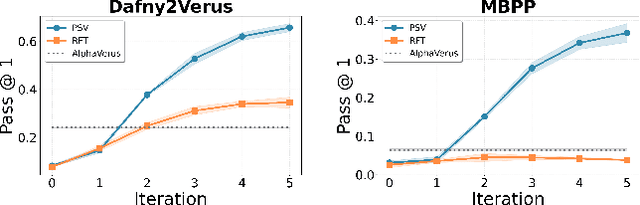
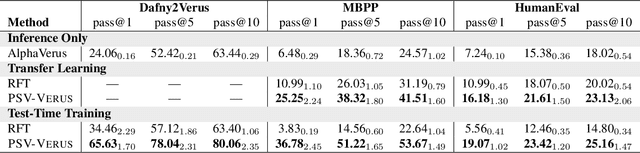
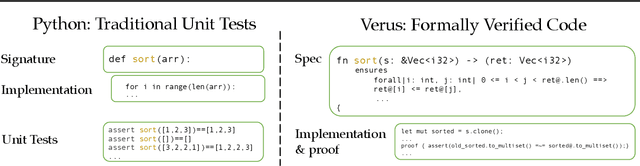

Training models through self-play alone (without any human data) has been a longstanding goal in AI, but its effectiveness for training large language models remains unclear, particularly in code generation where rewards based on unit tests are brittle and prone to error propagation. We study self-play in the verified code generation setting, where formal verification provides reliable correctness signals. We introduce Propose, Solve, Verify (PSV) a simple self-play framework where formal verification signals are used to create a proposer capable of generating challenging synthetic problems and a solver trained via expert iteration. We use PSV to train PSV-Verus, which across three benchmarks improves pass@1 by up to 9.6x over inference-only and expert-iteration baselines. We show that performance scales with the number of generated questions and training iterations, and through ablations identify formal verification and difficulty-aware proposal as essential ingredients for successful self-play.
OptimalThinkingBench: Evaluating Over and Underthinking in LLMs
Aug 18, 2025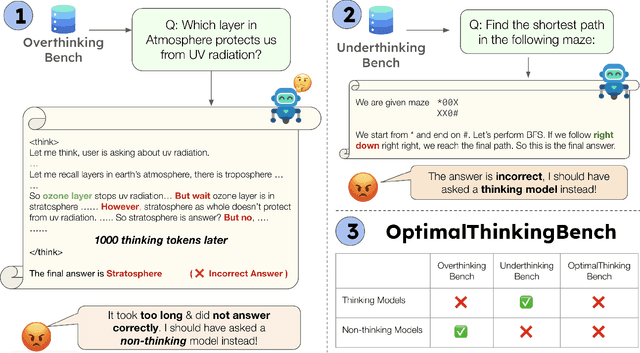
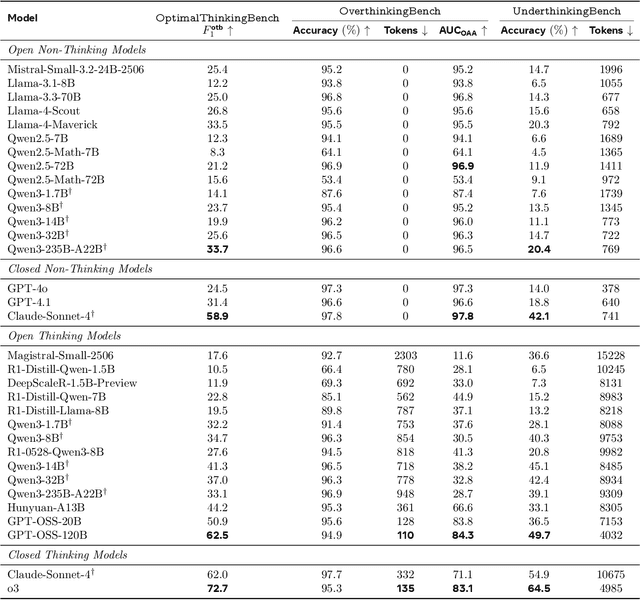
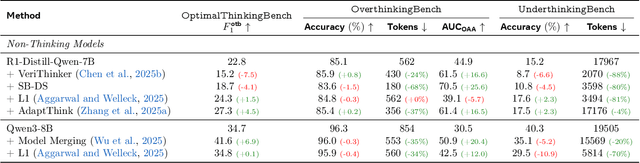
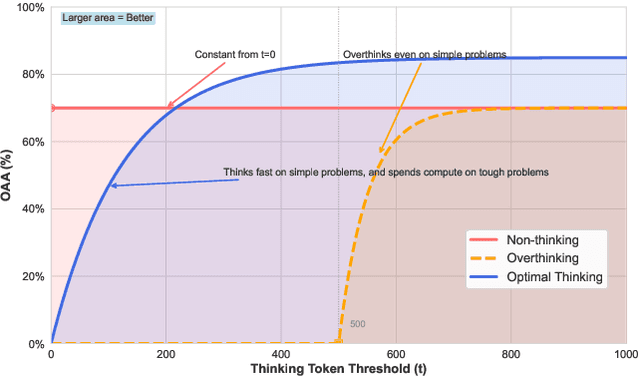
Thinking LLMs solve complex tasks at the expense of increased compute and overthinking on simpler problems, while non-thinking LLMs are faster and cheaper but underthink on harder reasoning problems. This has led to the development of separate thinking and non-thinking LLM variants, leaving the onus of selecting the optimal model for each query on the end user. In this work, we introduce OptimalThinkingBench, a unified benchmark that jointly evaluates overthinking and underthinking in LLMs and also encourages the development of optimally-thinking models that balance performance and efficiency. Our benchmark comprises two sub-benchmarks: OverthinkingBench, featuring simple queries in 72 domains, and UnderthinkingBench, containing 11 challenging reasoning tasks. Using novel thinking-adjusted accuracy metrics, we perform extensive evaluation of 33 different thinking and non-thinking models and show that no model is able to optimally think on our benchmark. Thinking models often overthink for hundreds of tokens on the simplest user queries without improving performance. In contrast, large non-thinking models underthink, often falling short of much smaller thinking models. We further explore several methods to encourage optimal thinking, but find that these approaches often improve on one sub-benchmark at the expense of the other, highlighting the need for better unified and optimal models in the future.
L1: Controlling How Long A Reasoning Model Thinks With Reinforcement Learning
Mar 06, 2025Reasoning language models have shown an uncanny ability to improve performance at test-time by ``thinking longer''-that is, by generating longer chain-of-thought sequences and hence using more compute. However, the length of their chain-of-thought reasoning is not controllable, making it impossible to allocate test-time compute to achieve a desired level of performance. We introduce Length Controlled Policy Optimization (LCPO), a simple reinforcement learning method that optimizes for accuracy and adherence to user-specified length constraints. We use LCPO to train L1, a reasoning language model that produces outputs satisfying a length constraint given in its prompt. L1's length control allows for smoothly trading off computational cost and accuracy on a wide range of tasks, and outperforms the state-of-the-art S1 method for length control. Furthermore, we uncover an unexpected short chain-of-thought capability in models trained with LCPO. For instance, our 1.5B L1 model surpasses GPT-4o at equal reasoning lengths. Overall, LCPO enables precise control over reasoning length, allowing for fine-grained allocation of test-time compute and accuracy. We release code and models at https://www.cmu-l3.github.io/l1
Programming with Pixels: Computer-Use Meets Software Engineering
Feb 24, 2025Recent advancements in software engineering (SWE) agents have largely followed a $\textit{tool-based paradigm}$, where agents interact with hand-engineered tool APIs to perform specific tasks. While effective for specialized tasks, these methods fundamentally lack generalization, as they require predefined tools for each task and do not scale across programming languages and domains. We introduce $\texttt{Programming with Pixels}$ (PwP), an agent environment that unifies software development tasks by enabling $\textit{computer-use agents}$-agents that operate directly within an IDE through visual perception, typing, and clicking, rather than relying on predefined tool APIs. To systematically evaluate these agents, we propose $\texttt{PwP-Bench}$, a benchmark that unifies existing SWE benchmarks spanning tasks across multiple programming languages, modalities, and domains under a task-agnostic state and action space. Our experiments demonstrate that general-purpose computer-use agents can approach or even surpass specialized tool-based agents on a variety of SWE tasks without the need for hand-engineered tools. However, our analysis shows that current models suffer from limited visual grounding and fail to exploit many IDE tools that could simplify their tasks. When agents can directly access IDE tools, without visual interaction, they show significant performance improvements, highlighting the untapped potential of leveraging built-in IDE capabilities. Our results establish PwP as a scalable testbed for building and evaluating the next wave of software engineering agents. We release code and data at https://programmingwithpixels.com
AlphaVerus: Bootstrapping Formally Verified Code Generation through Self-Improving Translation and Treefinement
Dec 09, 2024Automated code generation with large language models has gained significant traction, but there remains no guarantee on the correctness of generated code. We aim to use formal verification to provide mathematical guarantees that the generated code is correct. However, generating formally verified code with LLMs is hindered by the scarcity of training data and the complexity of formal proofs. To tackle this challenge, we introduce AlphaVerus, a self-improving framework that bootstraps formally verified code generation by iteratively translating programs from a higher-resource language and leveraging feedback from a verifier. AlphaVerus operates in three phases: exploration of candidate translations, Treefinement -- a novel tree search algorithm for program refinement using verifier feedback, and filtering misaligned specifications and programs to prevent reward hacking. Through this iterative process, AlphaVerus enables a LLaMA-3.1-70B model to generate verified code without human intervention or model finetuning. AlphaVerus shows an ability to generate formally verified solutions for HumanEval and MBPP, laying the groundwork for truly trustworthy code-generation agents.
RLHF Deciphered: A Critical Analysis of Reinforcement Learning from Human Feedback for LLMs
Apr 12, 2024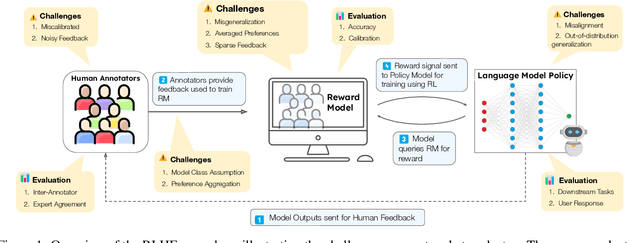


State-of-the-art large language models (LLMs) have become indispensable tools for various tasks. However, training LLMs to serve as effective assistants for humans requires careful consideration. A promising approach is reinforcement learning from human feedback (RLHF), which leverages human feedback to update the model in accordance with human preferences and mitigate issues like toxicity and hallucinations. Yet, an understanding of RLHF for LLMs is largely entangled with initial design choices that popularized the method and current research focuses on augmenting those choices rather than fundamentally improving the framework. In this paper, we analyze RLHF through the lens of reinforcement learning principles to develop an understanding of its fundamentals, dedicating substantial focus to the core component of RLHF -- the reward model. Our study investigates modeling choices, caveats of function approximation, and their implications on RLHF training algorithms, highlighting the underlying assumptions made about the expressivity of reward. Our analysis improves the understanding of the role of reward models and methods for their training, concurrently revealing limitations of the current methodology. We characterize these limitations, including incorrect generalization, model misspecification, and the sparsity of feedback, along with their impact on the performance of a language model. The discussion and analysis are substantiated by a categorical review of current literature, serving as a reference for researchers and practitioners to understand the challenges of RLHF and build upon existing efforts.